A new ‘superhuman’ tool for spotting heart disease, France slowed down fast fashion, and a near-extinct species bounced back, plus more good news
This week’s good news roundup
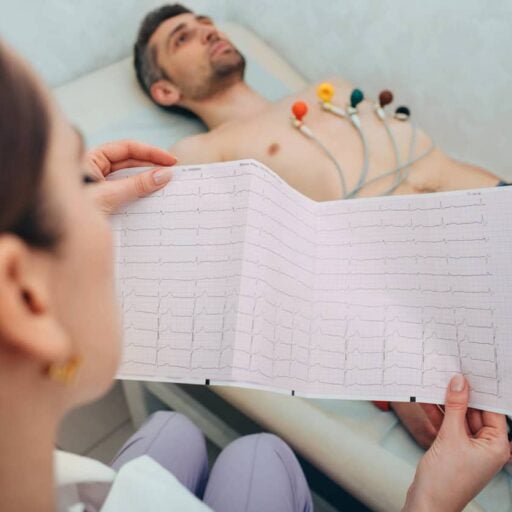
Software that can detect heart disease in seconds could help change the trajectory of the condition for millions of people, experts said this week.
The new tool, developed by Imperial College London, scans electrocardiograms (ECGs) for information that human cardiologists are unable to see.
ECGs record electrical activity in the heart and have long proved reliable in helping cardiologists diagnose heart attacks and abnormal rhythms. But even the most experienced among them are unable to detect signs of heart disease in ECG data. For that, they must carry out echocardiograms, which many patients wait months for – valuable time lost that could be spent seeing treatment.
“We looked at the ECGs to see if we could do things that are superhuman,” said Imperial’s Dr Arunashis Sau. “Not things that clinicians can already do, but things that no cardiologist, no matter how expert, can do.”
A trial involving 67,000 patients found that the tool successfully correctly identified up to 81% of patients who had heart failure and 90% of those who had heart valve disease. The results were presented at the European Society of Cardiology annual congress in Munich, Germany.
“A 10-second ECG, once a blunt screening tool, may soon become one of the most informative tests in medicine,” said Fu Siong Ng, professor of cardiology at Imperial. Dr Sonya Babu-Narayan, the British Heart Foundation’s clinical director, added: “When it comes to the heart, earlier diagnosis and treatment saves lives.”
Image: peakSTOCK

In further promising health news, a new urine test has correctly identified 92% of bladder cancer cases in a UK trial, raising hopes for speedier diagnoses of the disease.
The Galeas urine test was trialled on 964 patients across seven urology departments in England and Scotland. A study, led by the University of Birmingham, showed that it correctly identified 92.2% of cancer cases.
Welcoming the results, experts said the at-home test could spare patients from having an invasive cystoscopy, which involves inserting a small camera up the urethra, while also reducing the burden on health services.
“The results are very significant for clinical practice,” said Prof Richard Bryan, study co-author. “Only 8% of patients in the study were ultimately diagnosed with bladder cancer, which highlights the challenge facing [health] services, where large numbers of patients currently enter the same urgent diagnostic pathway despite most not having cancer.
“Galeas is a promising and less invasive test that can be easier to administer and make testing and screening for bladder cancer far easier.”
The peer-reviewed study was published in the journal European Urology Oncology on Wednesday. Further, larger studies are planned.
Image: Ridofranz

In a win for southeast Asia, Timor-Leste has defeated the world’s leading cause of infectious blindness – the last country in the region to do so.
On Thursday, the World Health Organization (WHO) validated Timor-Leste as having eliminated trachoma as a public health problem.
The disease is spread via contaminated fingers or flies that have come into contact with the eyes of an infected person, and is often prevalent in poorer regions. Improvements to sanitation, plus speedier diagnosis and antibiotic rollouts, are among the best tools to tackle the disease.
“The elimination of trachoma from the southeast Asia region is a significant step towards our global target of eliminating trachoma worldwide by 2030,” said Dr Tedros Adhanom Ghebreyesus, WHO director general. “[Timor-Leste] has shown how science and strong health systems can protect people from preventable blindness.”
Image: James Tay

Methane ‘super-emitter’ Turkmenistan has started plugging leaks in its oil and gas facilities to prevent the potent greenhouse gas from escaping, new UN data suggests.
While CO2 is synonymous with global warming, methane is a stronger, albeit shorter lived, greenhouse gas – one released via leaks on a massive scale around the world. In 2022, first-of-its kind satellite data pinpointed the sources of more than 1,000 such leaks (chiefly oil and gas fields), with Turkmenistan the main offender.
However, according to the Guardian, which first reported on methane super emitters, Turkmenistan has now plugged eight major leaks. The work was an “incredible first step”, the UN told the newspaper.
Repairing methane leaks is one of the most obvious climate solutions. The UN Methane Alert and Response System (Mars) sends alerts to counties about their leaks. Turkmenistan received the most (192) last year and responded to 20%, including with plans to fix them. The US, by contrast, was sent 138 but responded to none.
Despite the progress, there’s much work to be done with methane responsible for around a quarter of global emissions.
Image: Joost Potma

The French, renowned for setting trends, started a new one on Monday – imposing fees on garments that don’t meet environmental standards.
French politicians claim the move will address the growing environmental impact of ultra-fast fashion, which churns out cheap, synthetic garments that swiftly end up in landfill. It comes as a report reveals that the fashion industry’s already substantial emissions ballooned 14% in just two years.
However, the Chinese government has cried foul, claiming the legislation is designed to target Chinese e-commerce retailers, such as Shein and Temu, while letting European outlets off the hook.
Under the legislation, ultra-fast fashion will be determined by three factors: the volume of products available, how much they cost, and their repairability. Fees will range from €0.50 (£0.43) for underwear to €12 (£10.30) for a coat, with the total amount capped at 50% of the product’s sales price.
France is not acting alone in trying to reduce fashion’s footprint. New European Union rules banning the destruction of unsold garments – a common practice in the industry – came into force in August. Brands must now find alternative uses for unsold stock, such as donation and resale.
Related: The preloved pioneers sending secondhand fashion mainstream
Image: Romane Gautun

China’s energy transition passed a key threshold this week as figures showed solar panels overtook coal power plants as the country’s main source of power capacity.
Figures reported by state media on Tuesday suggested that China had 1,288 GW of solar capacity at the end of July, surpassing coal’s 1,285 GW for the first time.
There’s a catch, however. Despite its growing dominance in China, solar generates less energy than coal because the panels don’t work at night. According to official figures, wind and solar met 24.6% of China’s electricity needs in the first half of 2026, compared to 49.7% for coal.
That’s a lot of coal going up in smoke, but it’s also the first time coal dipped below the 50% mark since records began.
Image: Zhudifeng

Around half a million more pupils in England are now eligible for free school meals thanks to a rule change described as a “landmark” moment for children.
Under the new rules, all pupils in England whose parents receive Universal Credit – a means-tested welfare benefit – will be eligible for free school dinners.
The Food Foundation, a charity that long campaigned for the change, said the move “will ease pressure on families struggling with the cost of living”.
It comes amid a major overhaul of food standards in England’s schools, which aims to take processed, deep-fried and sugary foods off the menu, while increasing pupils’ intake of grains, pulses and vegetables.
Image: Monkey Business Images

The benefits of solar power are available to more people than ever in the UK after plug-in panels went on sale there for the first time.
The UK government recently relaxed the rules on plug-in panels, which have long been available in the European Union. The devices offer households a way of generating electricity without installing conventional rooftop arrays, meaning renters and people living in flats can also take advantage.
Unlike traditional arrays, the smaller, off-the-shelf systems can be positioned in a garden or, where rules permit, on a balcony. They feed electricity into the home via plug sockets.
According to the government, the panels could save households up to £150 a year on energy bills. The cheapest devices cost £599, meaning a four-year pay-back period. Prices are expected to fall.
“The arrival of plug-in solar panels represents a significant milestone in expanding access to clean energy,” said Joanna O’Loan from the Energy Saving Trust. “Plug-in solar panels will give more people greater control over their energy use and costs.”
Image: Yuma Solar

The population of a critically endangered parrot found only in New Zealand has reached a 75-year high.
Kākāpō, the world’s only nocturnal and flightless parrot, were common across New Zealand, until invasive cats and stoats pushed them to the brink of extinction in the 1900s.
A recovery programme launched in 1995 on the South Island, where predator-free habitats have been created. At the time, the population of the bird was just 51, but this week it was revealed that 90 chicks had been born this year, pushing the population to a recovery-era high of 325 birds.
“There is still a long road of recovery ahead, but 90 chicks in a single season is a record,” said Deidre Vercoe from the New Zealand department for conservation. “In the early years of recovery, it took 16 years to produce that many chicks. It’s a significant milestone for the species.”
Image: Department of Conservation

While tech-moguls pour billions into trying to live longer, the answer might well lie in Brazil.
Recent research suggests that the country has one of the highest concentrations of supercentenarians in the world – a striking fact in a nation better known for inequality, patchy healthcare and economic and social volatility.
New research – reported by Positive News this week – aims to find out what Brazil’s supercentenarians can teach the rest of the world about living longer, healthier lives.
“We are still collecting, still trying to understand,” one researcher told Positive News. “But already we see some very interesting patterns.”
Read the full story here.
Image: Vinicius Amano
Main image: Dusanpetkovic
Get your weekly fix of good news delivered to your inbox every Saturday, by signing up to the Positive News email newsletter
Be part of the solution
At Positive News, we’re not chasing clicks or profits for media moguls – we’re here to serve you and have a positive social impact. We can’t do this unless enough people like you choose to support our journalism.
Give once from just £1, or join 1,800+ others who contribute an average of £3 or more per month. Together, we can build a healthier form of media – one that focuses on solutions, progress and possibilities, and empowers people to create positive change.